Saturday 18 Sep 2021, 2:15 pm
West side of the J.B. Macdonald Building, 2199 Wesbrook Mall, UBC
Outdoor Art Launch: Works by Mayhew and Murray
-
Elza Mayhew
Elza Mayhew (1916–2004) was born in Victoria, BC. She received a BA from UBC (1936) and MFA (1963) from the University of Oregon. Mayhew was known for her abstract sculptures that were typically carved in polystyrene and then cast in aluminum or sometimes bronze. She worked primarily from sketches, rarely from models, and described her work as highly structured and architectural while always relating to the human form. Mayhew produced commissioned works for international events such as Expo 67, Expo 86 and an international trade fair in Tokyo, as well as for public institutions such as the Bank of Canada, the University of Victoria, the Canadian National Capital Commission and the Royal British Columbia Museum. Her work is included in the collections of the Art Gallery of Greater Victoria, the National Gallery of Canada, Simon Fraser University and the University of Victoria. Her sculpture Column of the Sea is located at the Confederation Centre of the Arts in Charlottetown. Mayhew was a member of the Royal Canadian Academy, and was an active member of the Limners Society.
Read More
-
Robert Murray
Robert Murray, sculptor, painter, printmaker and art teacher, was born in Vancouver in 1936 and grew up in Saskatoon. He began studying art in Saskatoon, taking courses at the Bedford Road Collegiate High School under Ernest Lindner (1897-1988) and at the Saskatoon Teachers’ College under Wynona Mulcaster (b. 1915). In 1960, after attending the Regina College School of Art (1956-1958) and the Emma Lake Artists’ Workshop led by Barnett Newman in 1959, Murray moved to New York City, where he studied at the Art Students’ League under Will Barnet (1911-2012). As an artist, Murray had started out as a painter and a printmaker but shifted his focus to sculpture beginning in 1959, when he accepted a commission to design a sculptural fountain for Saskatoon City Hall. The commission was Murray’s first attempt at designing large-scale sculptural works in metal fabricating plants. He continued in this vein in subsequent years, designing numerous monumental constructions in steel and aluminum, including the red painted steel sculpture entitled Ferus, which he produced at the Treitel-Gratz factory in New York in 1963. The work was installed on Lookout Island in Georgian Bay, ON and was shown at the Washington Square Gallery, New York in 1964 and at the Betty Parsons Gallery, New York, the following year. It was purchased in 1999 by the National Gallery of Canada, which held a Robert Murray retrospective entitled The Factory as Studio during that year. Along with the National Gallery of Canada, Murray’s work can be found in the collections of the Belkin, the Art Gallery of Ontario (Toronto), the Montreal Museum of Fine Arts, the New Brunswick Museum (Saint John) and the Whitney Museum of American Art (New York).
Read More
Please join us on Saturday, 18 September 2021 between 2:15 and 4 pm to celebrate the installation of Elza Mayhew’s Stela I and II (1963) and Robert Murray’s Cumbria (1966-67/1995). UBC President Santa Ono, Director Emeritus Scott Watson, Professor Emeritus John O’Brian and Curator Keith Wallace will be present to share remarks on the artworks; Cumbria artist Robert Murray will be in attendance. The event will begin at 2:15 pm at the site of Stela I and II, in the grassy area to the west of the Faculty of Dentistry (J.B. Macdonald Building); and at 3:15 pm at the site of Cumbria at the intersection of West Mall and University Boulevard (Ponderosa Commons).
Because event capacity is limited due to COVID-19 safety protocols, we ask that you RSVP for this outdoor event by emailing belkin.rsvp@ubc.ca. This event will take place rain or shine, so please dress for the weather and bring your own refreshments. For more information on planning your trip to campus, visit UBC Parking as well as Campus and Community Planning for printable maps.
The Belkin is also offering two Outdoor Art tours as part of UBC Homecoming 2021. The Decolonization Tour and the Ecologies and Economies Tour will take place on Saturday and Sunday, 18 and 19 September; more information and registration details can be found here.
Elza Mayhew’s Stela I and II were donated to the Belkin by the artist’s family in 2019 and installed in 2021. Siting a work of outdoor art involves taking stock of the relationships that make up a space, including its architectonic and natural topography and the presence of its human and non-human residents. Stela I and II, a pair of cast aluminum sculptures each weighing over 200 kilograms, stand flush with the ground in a cluster of willows, oak trees and conifers. They are surrounded by examples of modernist architecture whose materiality and visible structural anatomy are echoed in the horizontal and vertical lines and the geometric, window-like spaces that form the Stelae. Reflective of Mayhew’s devotion to the relationship between architecture and the human form, the works can be approached and experienced intimately from a multitude of directions.
In its new site, Robert Murray’s Cumbria presents rich opportunities for engagement with the work, whose angles and planes of saturated colour shift dramatically depending on the location from which it is viewed. The work sustained major damage in 1993 during its removal from the Vancouver Airport, where it was initially sited upon its return to Canada from Battery Park, New York in 1969. Two years later, it was donated to UBC by Transport Canada, where it was originally situated between the Belkin and Lasserre Building. Cumbria now stands in an active junction where its expansive steel forms have room to soar, in the best form it has known in decades.
Image (above): Elza Mayhew, Stela I and II (1963). Photo: Rachel Topham Photography
-
Elza Mayhew
Elza Mayhew (1916–2004) was born in Victoria, BC. She received a BA from UBC (1936) and MFA (1963) from the University of Oregon. Mayhew was known for her abstract sculptures that were typically carved in polystyrene and then cast in aluminum or sometimes bronze. She worked primarily from sketches, rarely from models, and described her work as highly structured and architectural while always relating to the human form. Mayhew produced commissioned works for international events such as Expo 67, Expo 86 and an international trade fair in Tokyo, as well as for public institutions such as the Bank of Canada, the University of Victoria, the Canadian National Capital Commission and the Royal British Columbia Museum. Her work is included in the collections of the Art Gallery of Greater Victoria, the National Gallery of Canada, Simon Fraser University and the University of Victoria. Her sculpture Column of the Sea is located at the Confederation Centre of the Arts in Charlottetown. Mayhew was a member of the Royal Canadian Academy, and was an active member of the Limners Society.
Read More
-
Robert Murray
Robert Murray, sculptor, painter, printmaker and art teacher, was born in Vancouver in 1936 and grew up in Saskatoon. He began studying art in Saskatoon, taking courses at the Bedford Road Collegiate High School under Ernest Lindner (1897-1988) and at the Saskatoon Teachers’ College under Wynona Mulcaster (b. 1915). In 1960, after attending the Regina College School of Art (1956-1958) and the Emma Lake Artists’ Workshop led by Barnett Newman in 1959, Murray moved to New York City, where he studied at the Art Students’ League under Will Barnet (1911-2012). As an artist, Murray had started out as a painter and a printmaker but shifted his focus to sculpture beginning in 1959, when he accepted a commission to design a sculptural fountain for Saskatoon City Hall. The commission was Murray’s first attempt at designing large-scale sculptural works in metal fabricating plants. He continued in this vein in subsequent years, designing numerous monumental constructions in steel and aluminum, including the red painted steel sculpture entitled Ferus, which he produced at the Treitel-Gratz factory in New York in 1963. The work was installed on Lookout Island in Georgian Bay, ON and was shown at the Washington Square Gallery, New York in 1964 and at the Betty Parsons Gallery, New York, the following year. It was purchased in 1999 by the National Gallery of Canada, which held a Robert Murray retrospective entitled The Factory as Studio during that year. Along with the National Gallery of Canada, Murray’s work can be found in the collections of the Belkin, the Art Gallery of Ontario (Toronto), the Montreal Museum of Fine Arts, the New Brunswick Museum (Saint John) and the Whitney Museum of American Art (New York).
Read More
Related
-
News
14 Nov 2018
Outdoor Art: Fall 2018
 [more]
Jana Tyner
-
News
02 Dec 2019
Outdoor Art: Winter 2019
 [more]
Jana Tyner
-
Tour
18 Sept 2021
19 Sept 2021
Homecoming 2021: Outdoor Art Tours
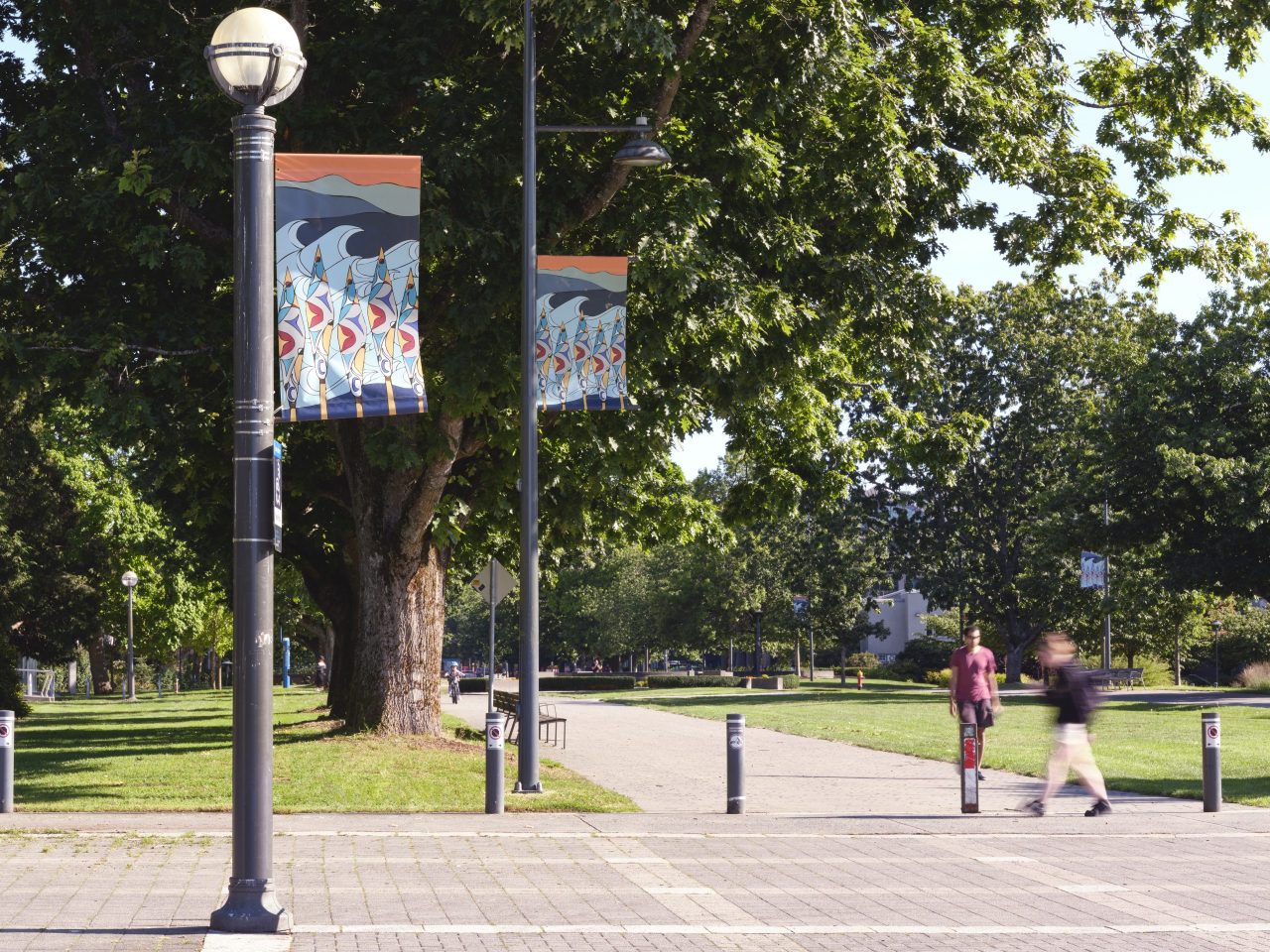
Join us for a tour of selected works in the Outdoor Art Collection on UBC's Vancouver campus. Taking place during the 2021 UBC Homecoming weekend, the tours will centre on questions of home, territory, and relationships to the land that UBC's Vancouver campus occupies, which is the traditional, ancestral and unceded territory of the xʷməθkʷəy̓əm (Musqueam) people. This year, we are offering two tours. Tours can accommodate up to fifteen people, and slots will be reserved in advance on a first-come first-serve basis.
[more]